Noul
Probability of yes on a binary question, with [P(no), P(yes)].
0
1
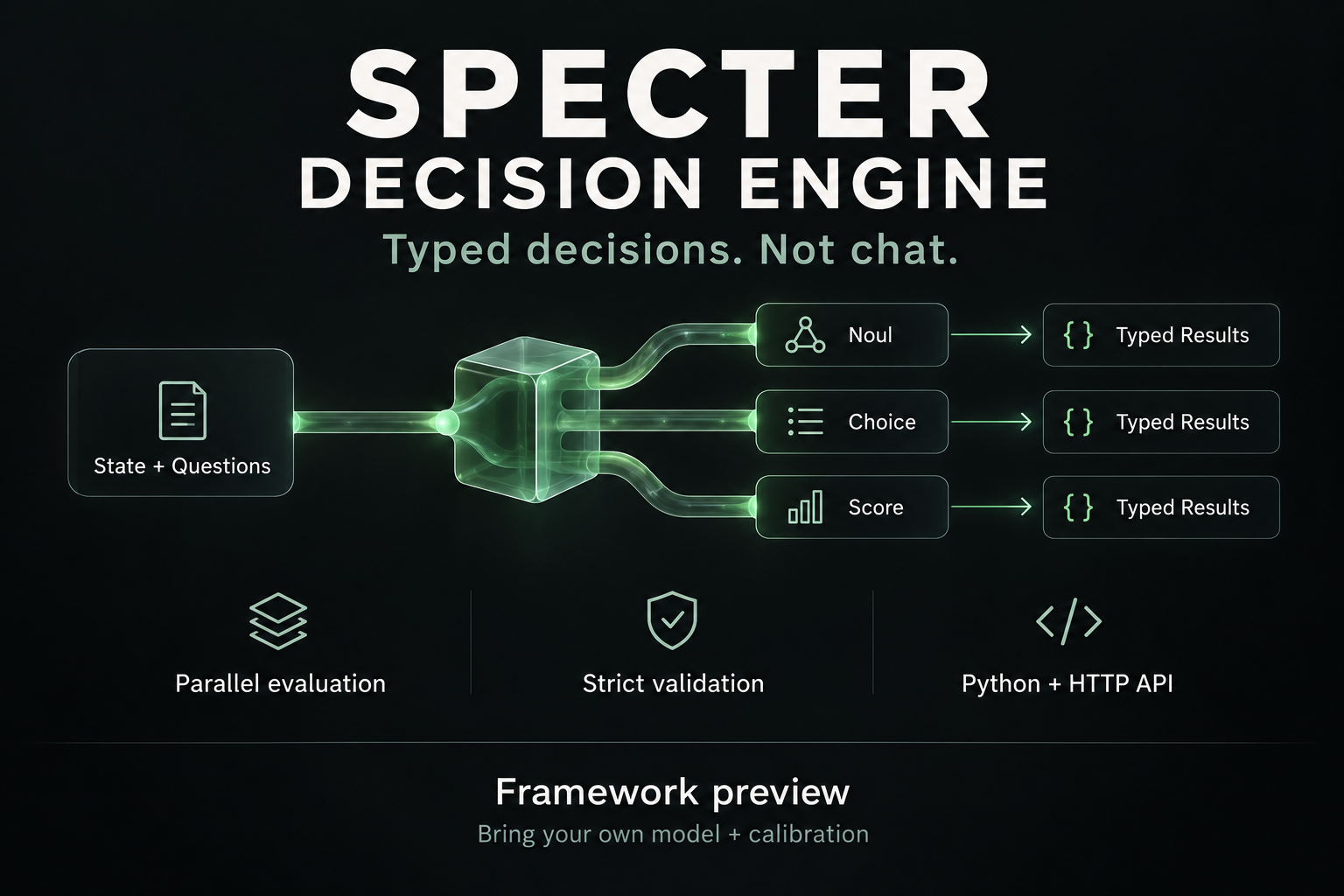
Specter turns application state into bounded, typed numeric decisions — Noul, Choice, and Score — with canonical snapshots, batch-native backends, versioned calibration and explicit failure states.
{
  "id": "route",
  "type": "choice",
  "status": "ok",
  "value": "engineering",
  "probabilities": [0.05, 0.85, 0.10],
  "confidence": 0.81
}The framework keeps the decision surface deliberately small. Your backend supplies finite logits; Specter validates, calibrates, projects and returns a predictable contract.
Probability of yes on a binary question, with [P(no), P(yes)].
One option from an explicit candidate set. Deterministic argmax projection.
A continuous expected level over an ordered rubric you define.
Each evaluation sees the same immutable state snapshot, not preceding answers.
Timeouts, invalid outputs and missing calibration are typed failure states.
Temperature, isotonic calibration and versioned domain artifacts keep uncertainty explicit.
0.3.0 moves shared-state work into the kernel. A BatchBackend can prefill the state once for N question heads, while signature deduplication collapses repeated work before calibration and projection.
Engineering measurements use the repository benchmark on Linux x86_64, 1 vCPU, 4 GiB RAM and CPython 3.12.3. They measure kernel mechanics with cheap local backends — not model intelligence or universal production latency.
The published benchmark isolates snapshot, validation, scheduling, softmax and projection. It deliberately does not claim semantic quality or trained-model speed.
231,293 typed decisions/s on the recorded 1-vCPU run.
The pinned 0.3.0 wheel is served with this page. Create an isolated environment, install the exact artifact, then inspect capabilities. No Git clone required.
Keep Specter isolated from your system Python.
The command below resolves to this site's checksum-pinned build of the tagged source.
Confirm version and contract, then optionally benchmark your own hardware.
Important: Specter 0.3.0 is a beta framework build. The bundled System-One local backend is an auditable lexical baseline, not a trained semantic model. A successful install or benchmark does not certify domain accuracy, calibration quality or production readiness.
The site publishes a concise /llms.txt entry point plus a pinned install brief. An agent gets the exact artifact, SHA-256, environment rules, capability verification and the limits it must not silently cross.
Shareable endpoint
Python applications can call the SDK directly. Specter Core can use the BaseHTTPRequestHandler adapter, while other runtimes integrate through the authenticated HTTP contract and OpenAPI schema.
/v1/decision/evaluate/v1/decision/capabilities/v1/decision/openapi.json